
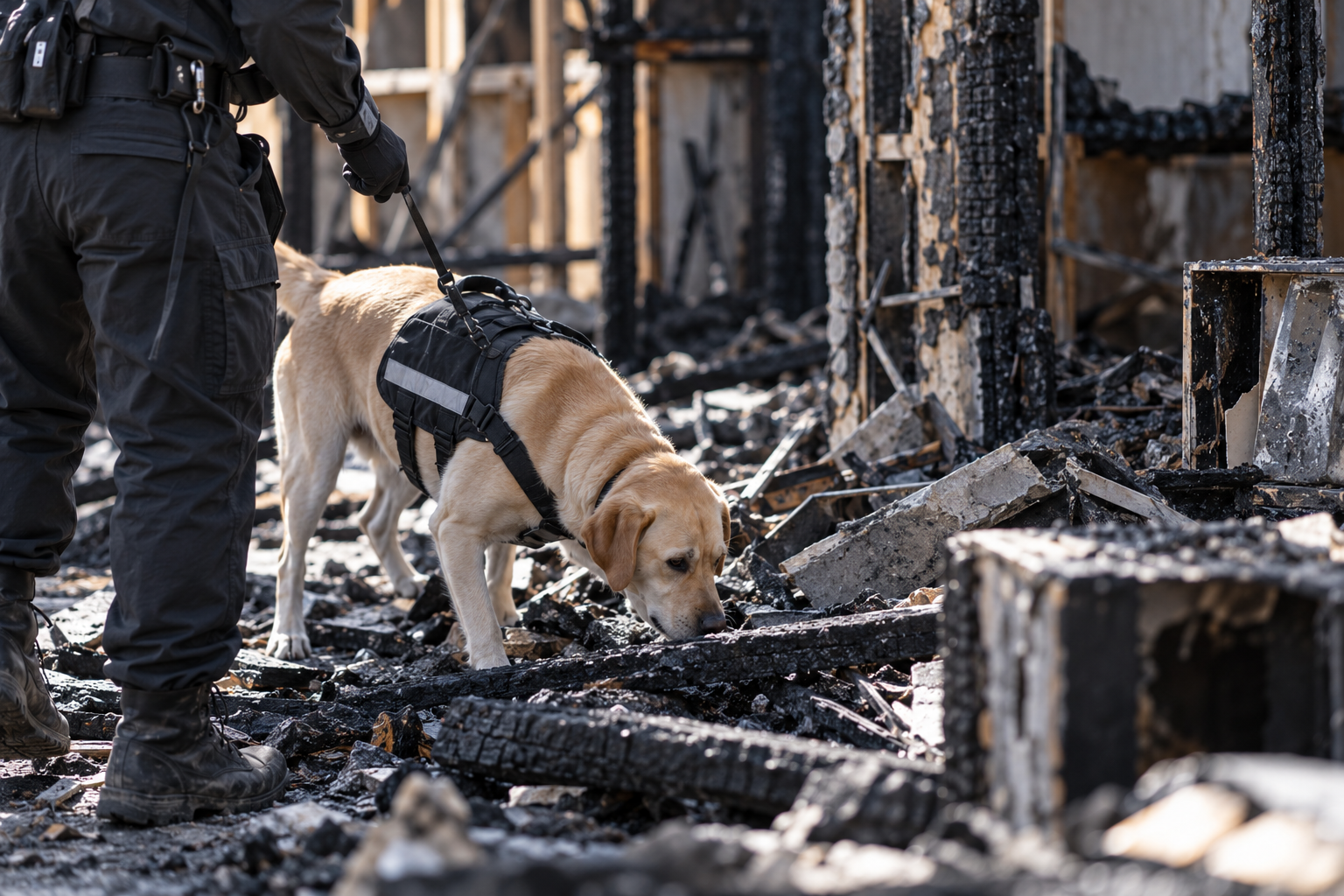
When a fire occurs, determining its origin and cause can be a complex process. Investigators may need to evaluate damaged structures, examine physical evidence, and consider multiple possible ignition sources. In some cases, identifying whether an ignitable liquid was present is an important part of that work.
K9 accelerant detection can provide valuable investigative support. Specially trained detection dogs use their sense of smell to identify odours associated with ignitable liquids, helping investigators identify areas that may warrant further examination.
For insurance professionals, legal teams, industrial operators, and other organizations involved in fire-related investigations, understanding the role of a detection dog can help clarify how this specialized resource contributes to a broader forensic investigation.
What Is K9 Accelerant Detection?
K9 accelerant detection involves the use of a specially trained dog to detect odours associated with ignitable liquids that may be present at a fire scene.
The term accelerant is commonly used in fire investigation when referring to substances that can contribute to the ignition or spread of a fire. Ignitable liquids may include products such as gasoline, diesel, kerosene, and other petroleum-based substances. After a fire, traces of these liquids may be difficult to identify visually. Fire damage, debris, and other scene conditions can complicate an investigator’s assessment. A detection dog may help identify locations where further examination is appropriate.
The dog’s role is specific: it detects target odours and alerts its handler to potential areas of interest. It does not independently determine how a fire started or establish whether a fire was intentionally set.
INTERNAL LINK: Link “fire origin and cause investigation” to Clearwater’s September 2026 article.
How Do Accelerant Detection Dogs Support an Investigation?
A K9 team’s contribution begins with detecting a potential odour of interest. The handler observes the dog’s response and documents relevant findings for consideration by the investigating professionals. The information can help investigators decide where additional attention may be warranted.
Depending on the circumstances, an alert may identify an area that requires closer examination or further evaluation of potential evidence. This is particularly relevant when a fire scene contains extensive damage or when the presence of an ignitable liquid is one of several questions under investigation.
A dog’s alert is not, by itself, confirmation that an ignitable liquid was used to start a fire. Investigators must consider the alert in the context of the scene, the available physical evidence, and other relevant information. The dog contributes useful information to a methodical, evidence-based investigation.
When Are K9 Teams Used in Fire Investigations?
A detection dog may be considered during investigations involving residential or commercial structures, industrial facilities, vehicles, or other fire scenes where the potential presence of an ignitable liquid is relevant.
For example, an investigation may involve competing explanations for how a fire began. If the possibility of an ignitable liquid is relevant to the inquiry, K9 detection may help investigators identify areas for further assessment.
In industrial and resource-sector environments, the circumstances can be more complex. Equipment, machinery, stored materials, and the operating environment may all form part of the broader investigation. The appropriate investigative resources depend on the specific incident and the evidence available.
INTERNAL LINK: Link “industrial fire investigations” to Clearwater’s Industrial Fire Investigation service page.
K9 deployment is not necessary in every fire investigation. Its value depends on whether detection support is relevant to the investigative questions and whether the scene conditions are suitable.
Why a K9 Alert Is Not Standalone Evidence
One of the most important points about accelerant detection is that an alert must be interpreted alongside other evidence. A detection dog may identify a target odour, but the presence of an ignitable liquid does not automatically determine deliberate ignition.
Additional examination or analysis may be needed to evaluate the significance of a finding, including the source of the odour, how a substance came to be present, or whether it played a role in ignition. There may be other explanations for its presence, and those possibilities must be assessed in context.
Investigators must consider the broader circumstances before reaching conclusions. Relevant considerations may include the physical condition of the scene, the location of potential evidence, the fire damage patterns, and other information gathered during the investigation.
A sound forensic conclusion depends on the overall body of evidence, not simply on whether a detection dog alerts at a particular location.
The Importance of Documentation and Independent Assessment
Fire investigations may have implications for insurance claims, civil disputes, regulatory matters, or litigation. In these settings, it is important to understand how investigative observations fit into the overall technical assessment.
Clear documentation helps distinguish what was observed from what can reasonably be concluded. The dog’s response, the location involved, and the circumstances of the investigation may all be relevant to understanding the findings.
The interpretation of those findings requires professional judgement and consideration of the available evidence. Where a fire investigation becomes part of a legal proceeding, technical findings and expert opinions may help the relevant parties assess the circumstances of the incident.
INTERNAL LINK: Link “expert witness services” to Clearwater’s Expert Witness / Litigation Support service page.
Fire investigators provide technical findings and opinions within their professional role. Questions of legal liability, insurance coverage, or other formal determinations remain with the appropriate decision-makers.
When Should You Consider K9 Accelerant Detection?
The decision to use a detection dog should be based on the specific investigative objectives, the scene conditions, and the professional assessment of the case.
K9 accelerant detection may be worth considering when the potential presence of an ignitable liquid is a relevant question in a fire investigation. Insurance adjusters, claims professionals, legal counsel, commercial property owners, industrial operators, and other organizations may need specialized investigative support when the circumstances of a fire are uncertain or require further technical assessment.
Clearwater Fire Forensics provides specialized fire investigation services in Edmonton, throughout Alberta, and across Western Canada. Its work includes fire origin-and-cause investigations and specialized investigations involving structural fires, vehicles, heavy equipment, industrial facilities, and other fire-related incidents.
For organizations evaluating the investigative needs of a particular incident, understanding the role of K9 accelerant detection is one part of determining which resources may be appropriate.
INTERNAL LINK: Link “fire investigation services” to Clearwater’s main Fire Investigation service page.
Conclusion
K9 accelerant detection can be a valuable component of a fire investigation when the potential presence of an ignitable liquid is relevant to determining a fire’s origin and cause.
Detection dogs help identify potential areas of interest, but their alerts must be evaluated alongside the wider body of evidence. A methodical approach ensures that observations are interpreted carefully and that investigative conclusions remain grounded in the available information.
For insurers, legal professionals, and organizations dealing with complex fire incidents, this distinction is essential to understanding how specialized detection support contributes to a professional forensic investigation.
Frequently Asked Questions
What is K9 accelerant detection?
K9 accelerant detection uses specially trained dogs to identify odours associated with ignitable liquids at fire scenes. Their alerts help investigators identify locations that may require further examination.
What types of liquids can an accelerant detection dog detect?
Depending on the dog’s training, target odours may include those associated with gasoline, diesel, kerosene, and other petroleum-based ignitable liquids. The substances a particular team is trained to detect should be confirmed with the service provider.
Does a K9 alert prove that a fire was deliberately set?
An alert indicates a potential target odour, not deliberate ignition. Investigators must assess the finding alongside other evidence and consider the circumstances in which the substance may have been present.
When are K9 teams used during a fire investigation?
A K9 team may be used when the possible presence of an ignitable liquid is relevant to the investigation. Deployment depends on the investigative questions, scene conditions, and professional assessment of the incident.
Why is additional evidence important after a K9 alert?
A dog’s response alone cannot establish the origin or cause of a fire. Investigators consider the alert alongside scene observations, physical evidence, and other relevant information before drawing conclusions.
Who may require K9 accelerant detection services?
Insurance companies, claims professionals, legal counsel, industrial operators, property owners, and other organizations may require this specialized support when investigating a fire.
Can K9 accelerant detection findings be relevant to litigation?
Yes. Findings may form part of the broader technical evidence considered in a legal matter. Their significance depends on the circumstances and the complete investigative record. Legal conclusions remain the responsibility of the appropriate decision-makers.
Does Clearwater Fire Forensics provide fire investigation services outside Edmonton?
Clearwater Fire Forensics is based in Edmonton, Alberta, and its stated service area includes Alberta and Western Canada. The suitability and availability of specific investigative services should be confirmed for each incident.